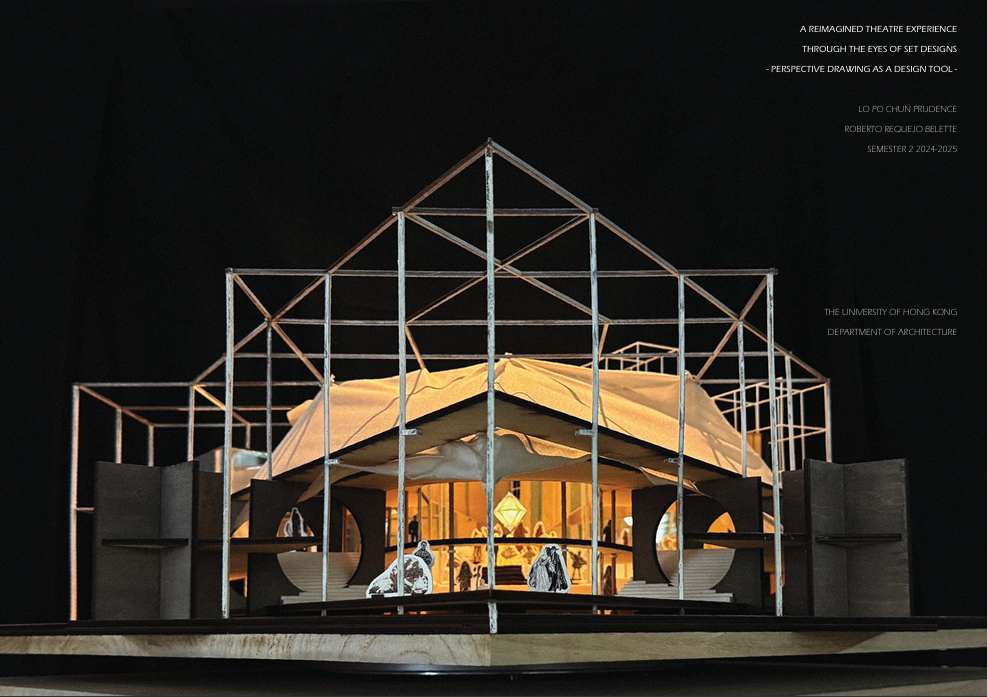
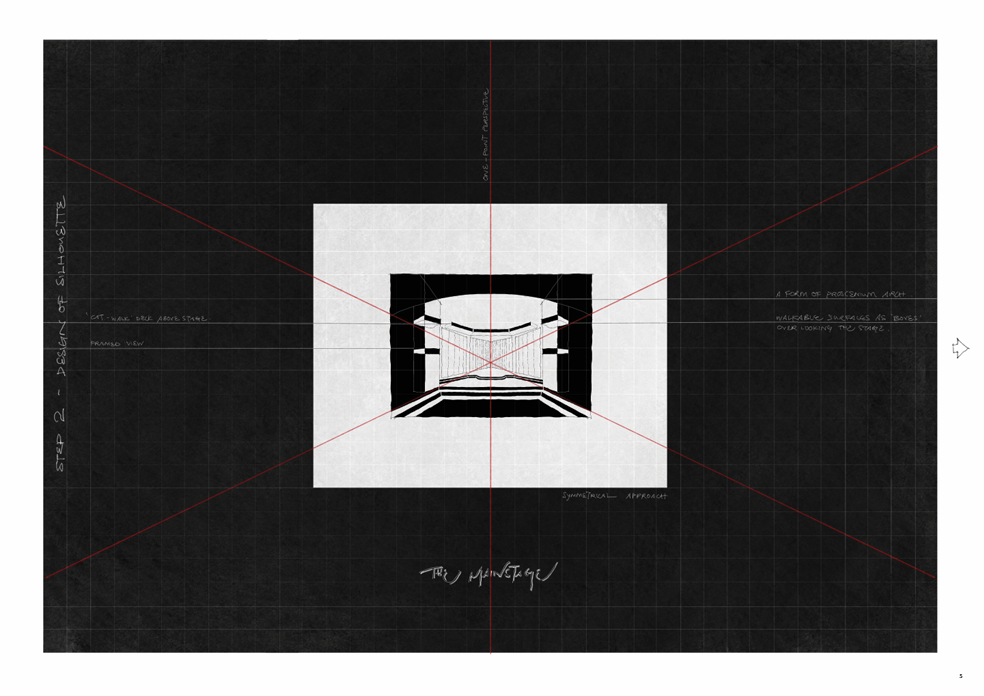
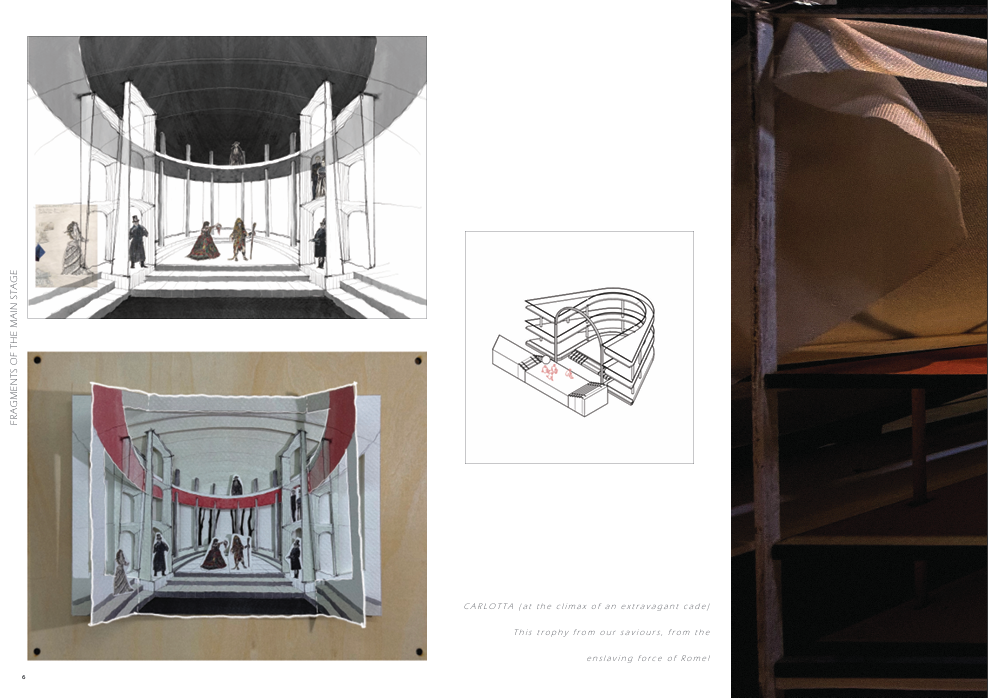
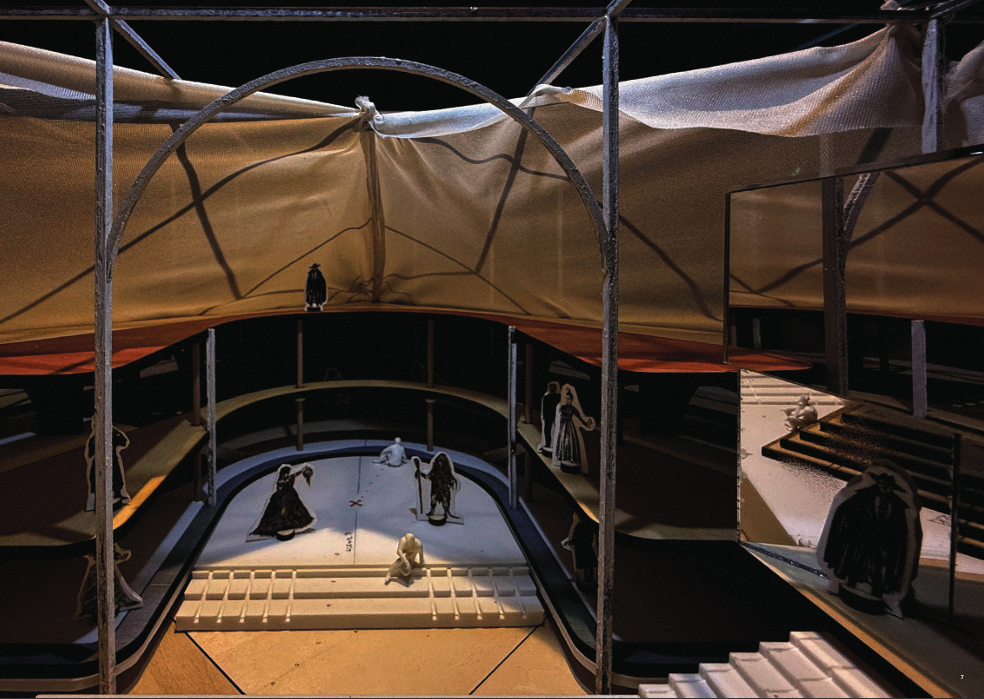
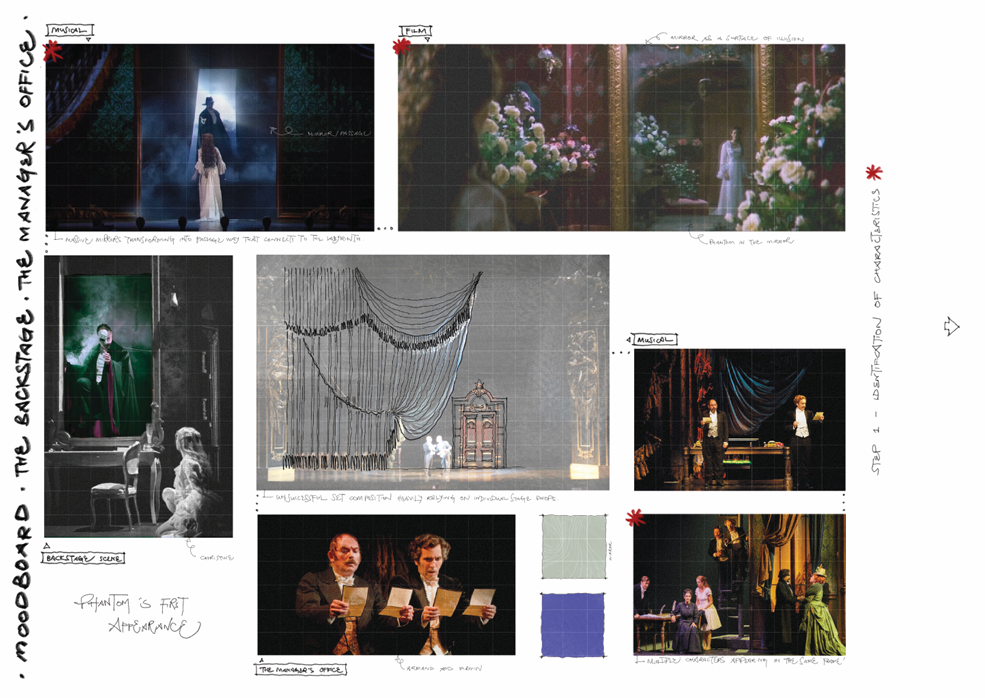
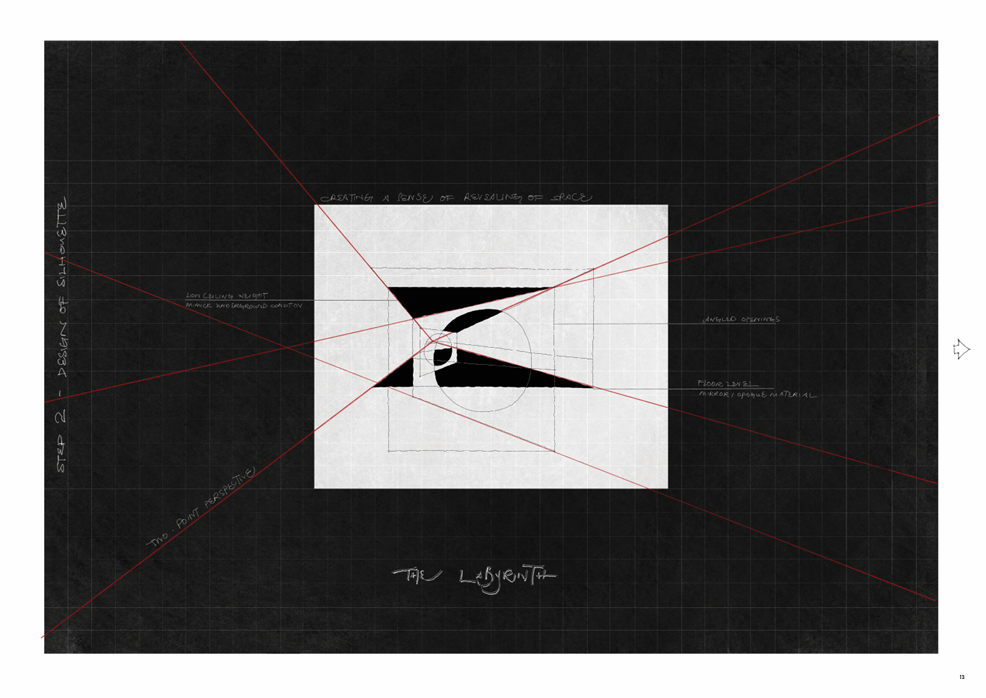
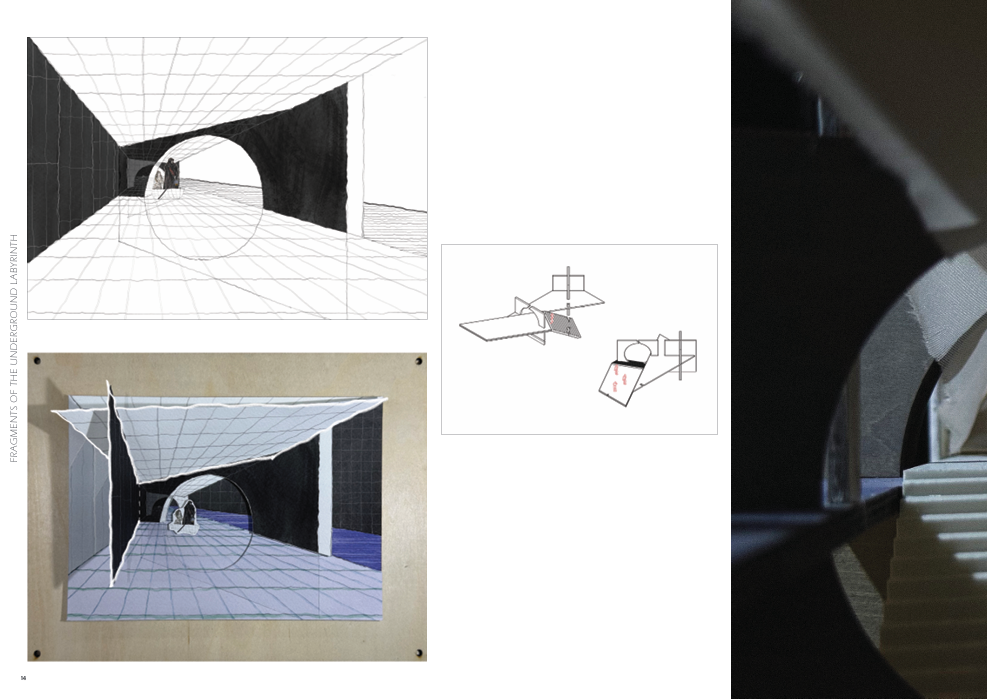
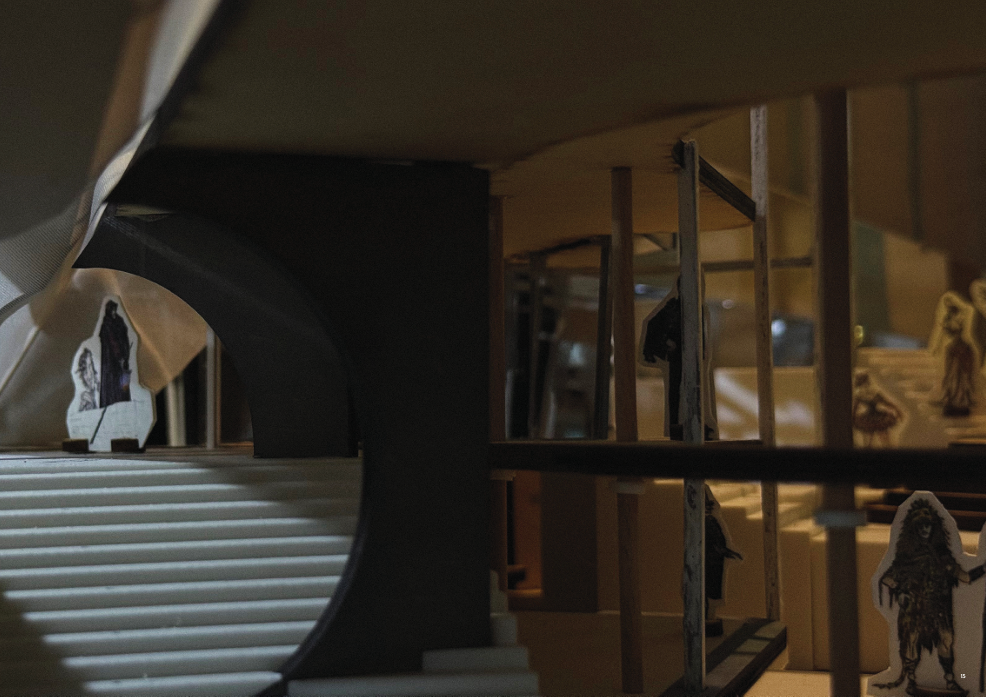
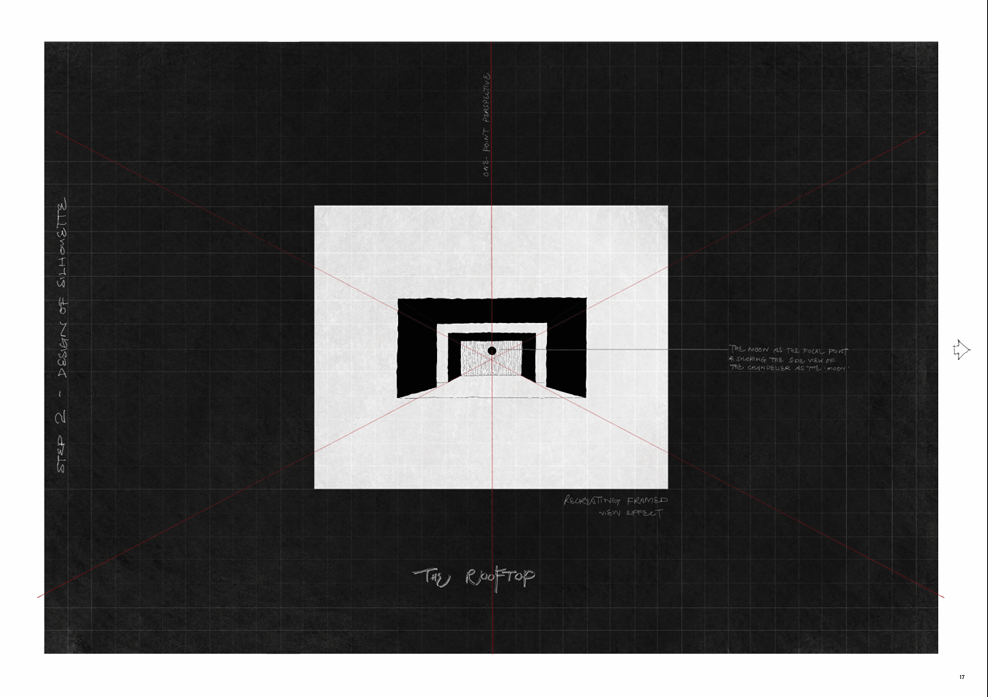
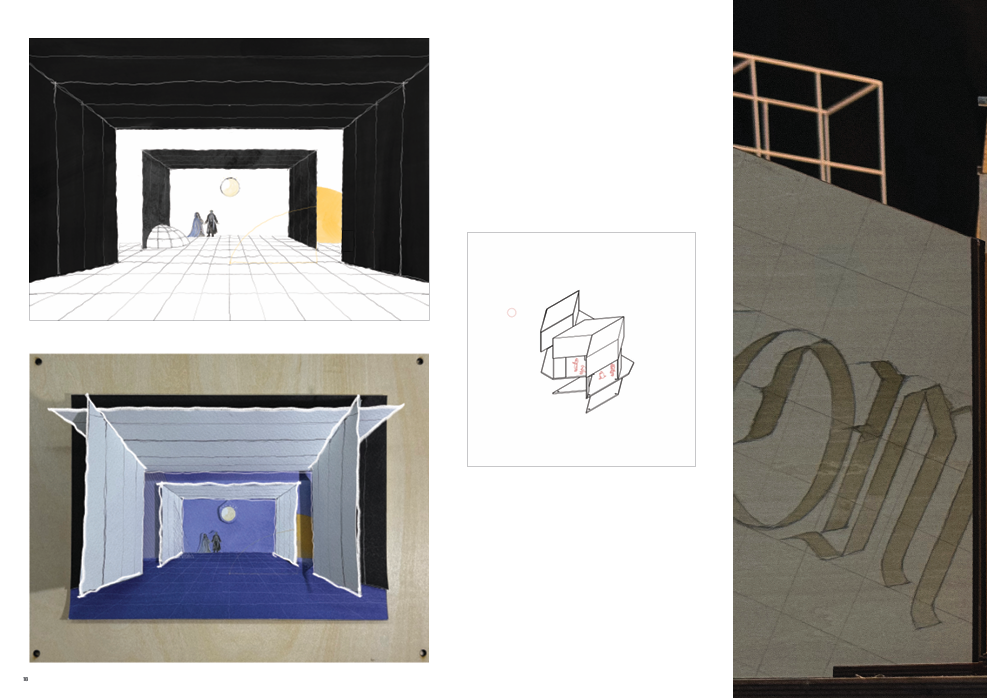
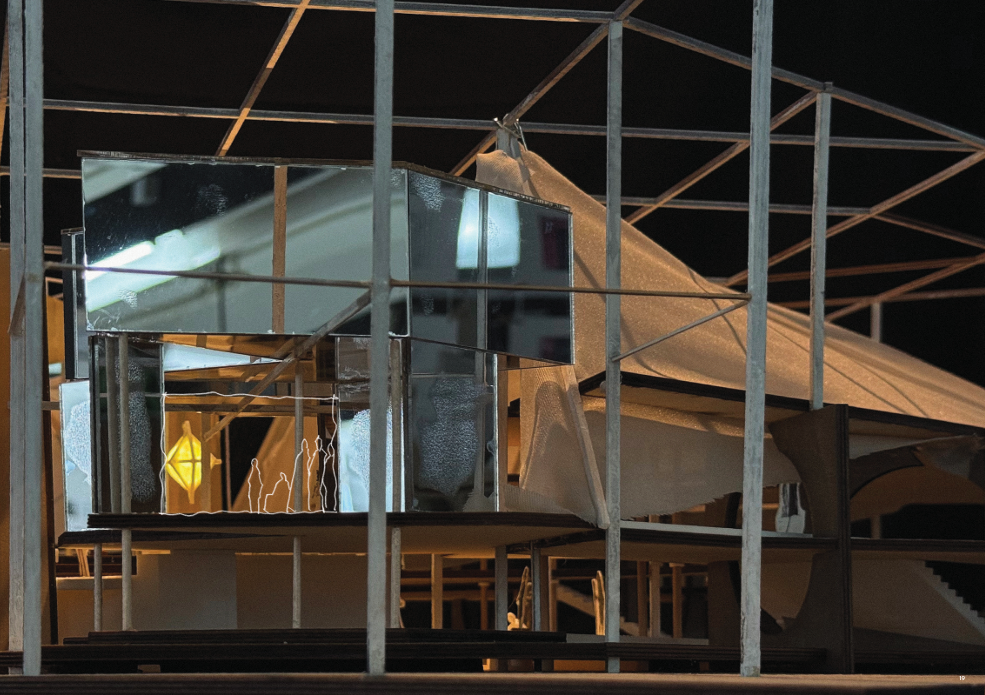
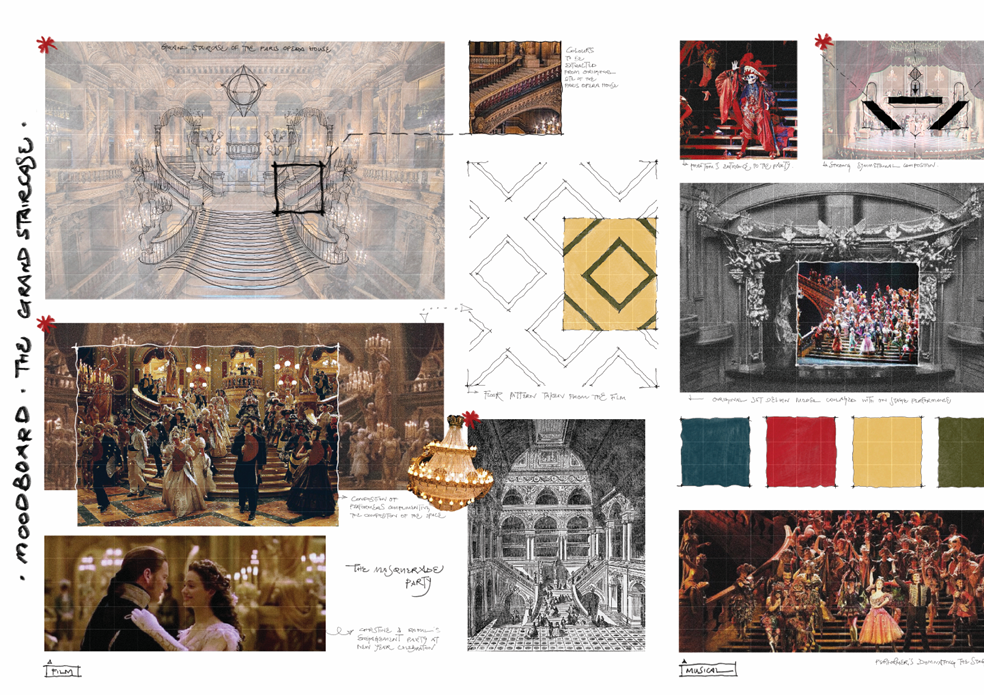
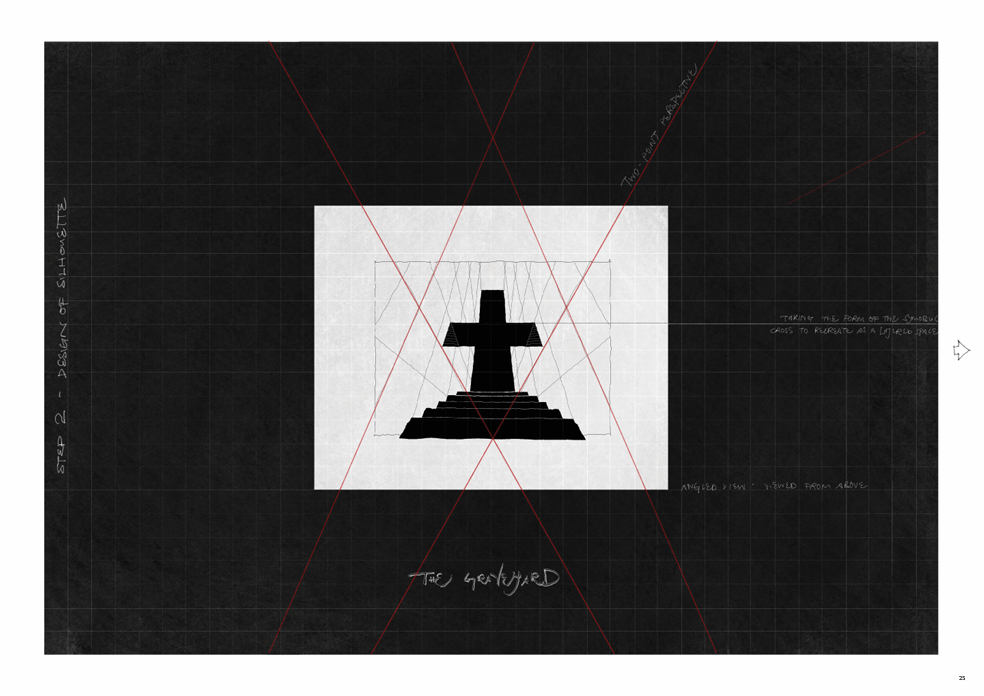
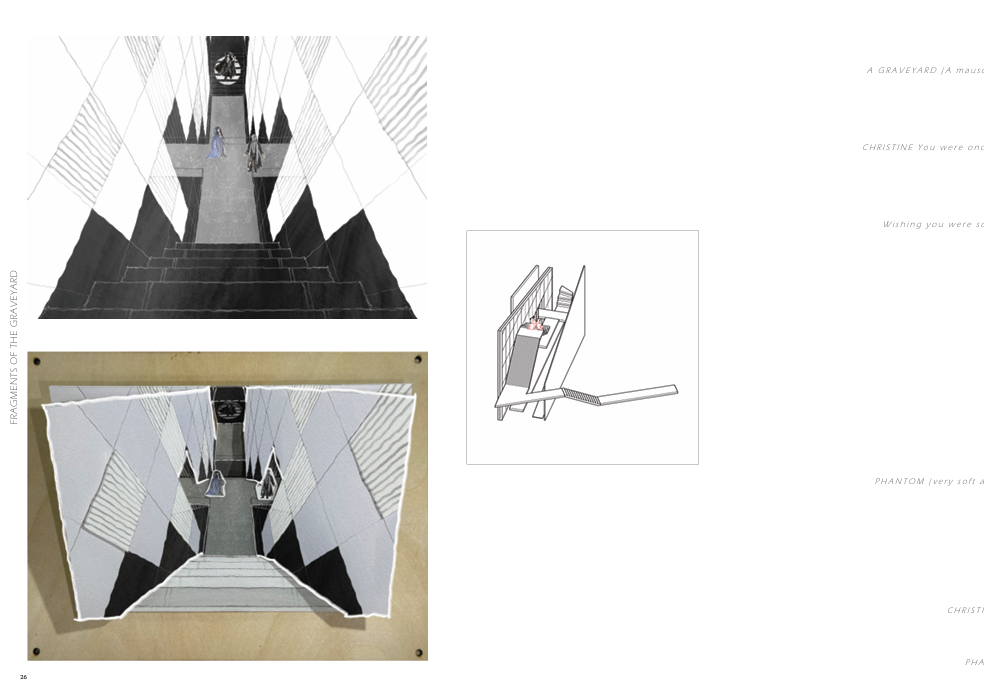
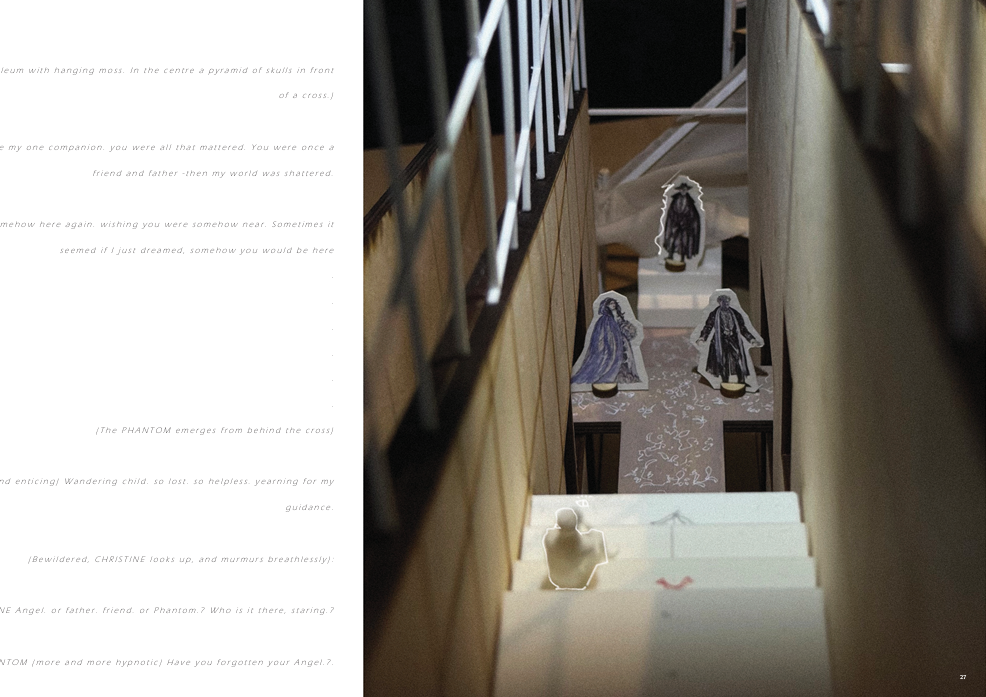
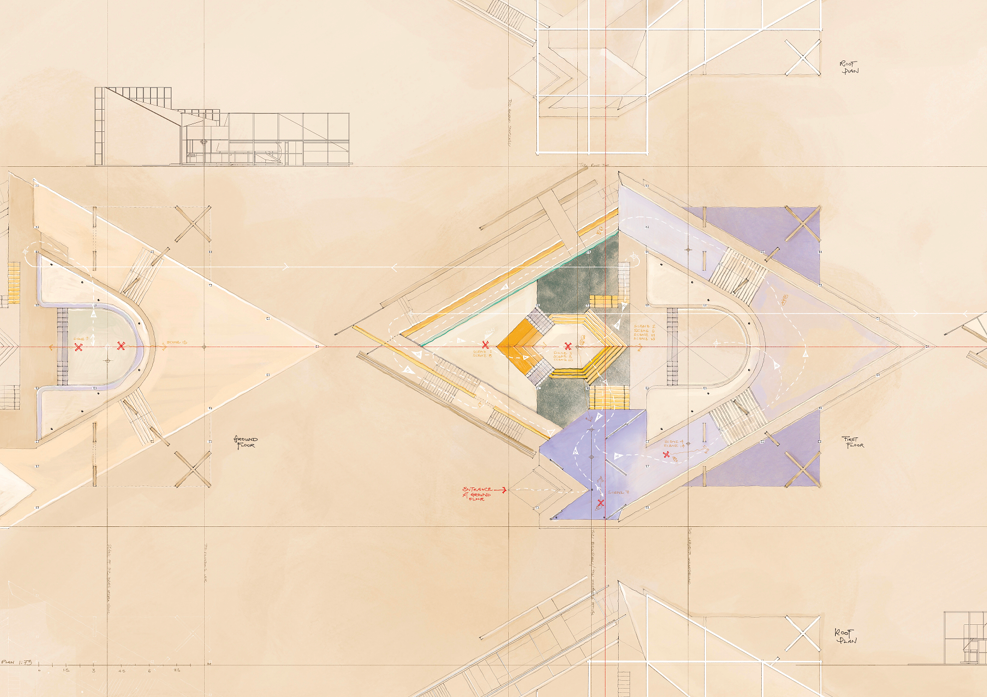
劇場空間展現為由「門檻」與「框景」所構成的場域。觀眾多數時間停留於觀眾席中,從固定視角經歷整個劇場旅程。這種典型的劇場配置限制了觀眾、表演者與設計空間之間的互動。本研究旨在探索透視圖的潛力,這是一種由方法論驅動的研究,鼓勵直覺且主動參與圖像創作,進而影響人們在劇場空間中的體驗。
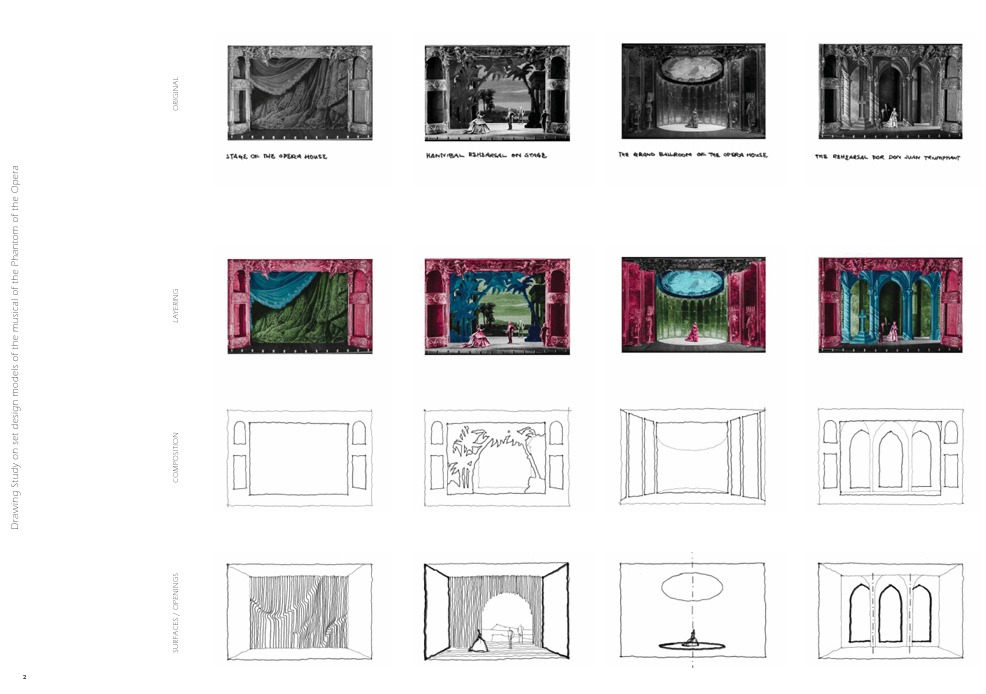
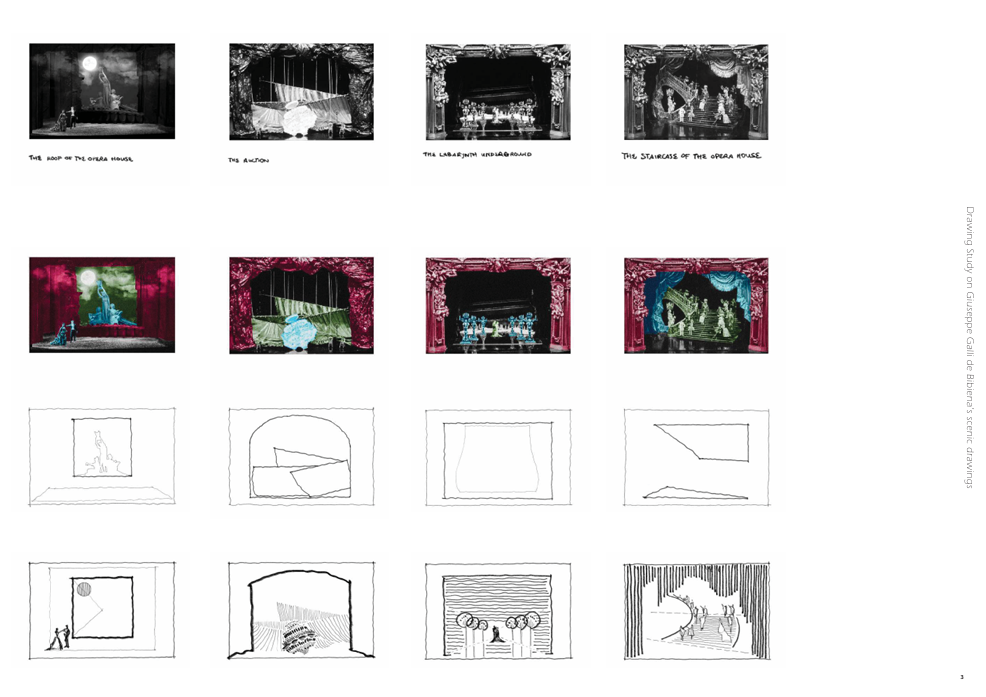
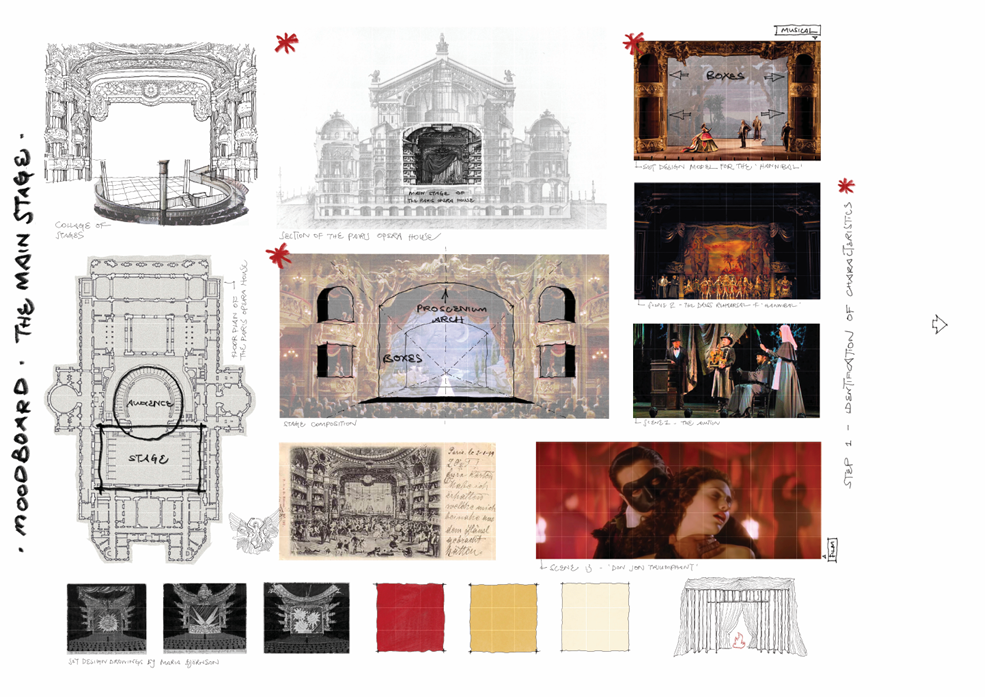
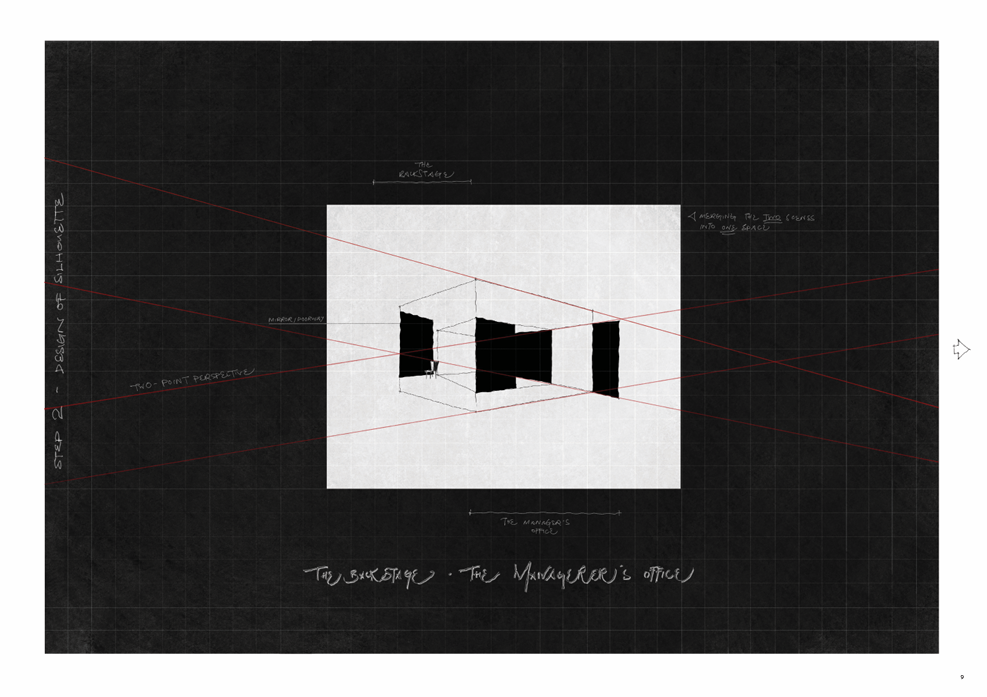
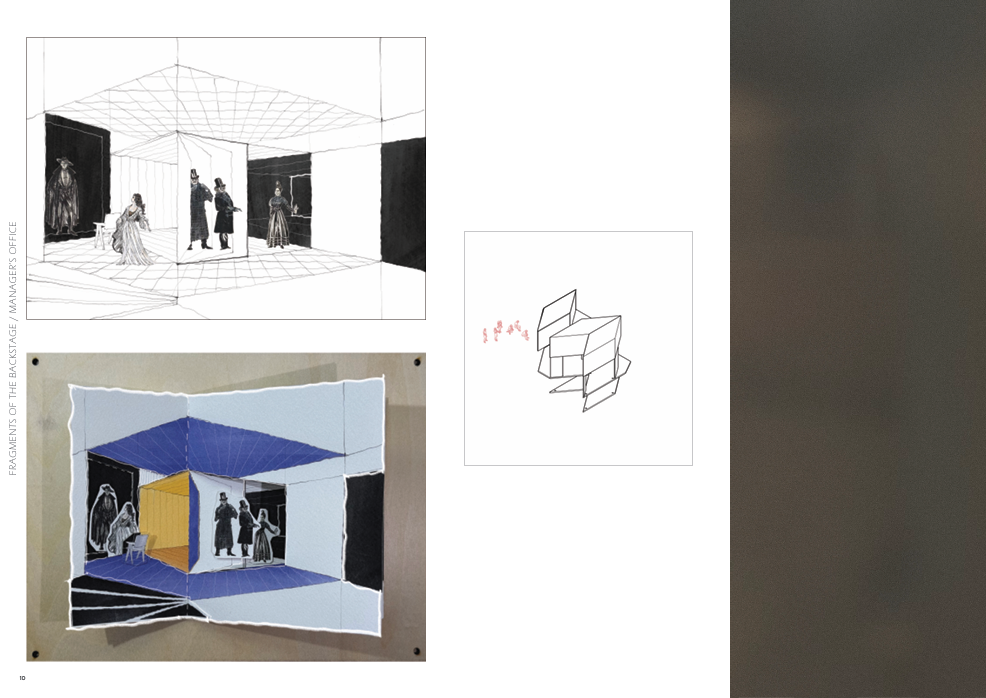
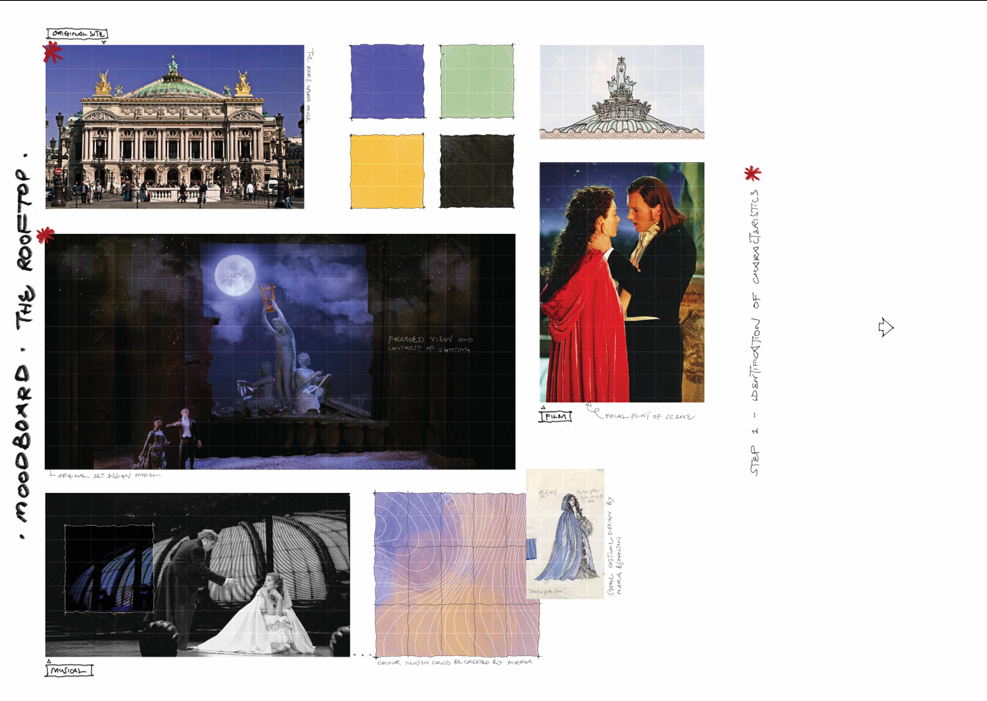
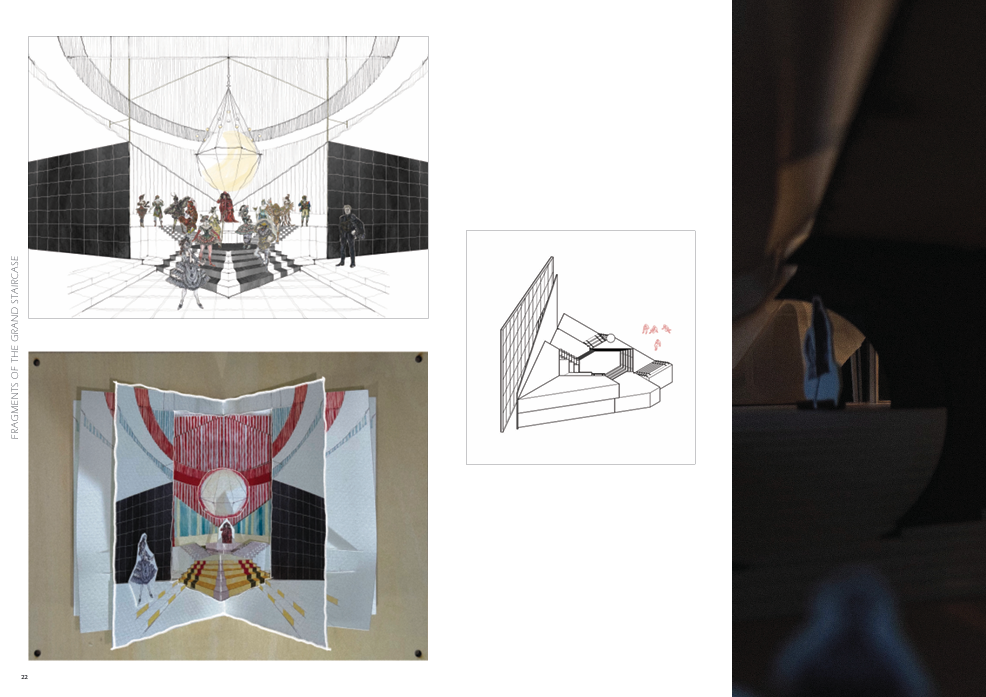
透過對巴洛克舞台設計師朱塞佩・加利・比比納(Giuseppe Galli Bibiena)舞台設計的研究,本論文發展出一套透視法的方法論。透過解析比比納的透視圖,並以經典作品《歌劇魅影》作為實驗對象,反向運用所建立的方法來進行空間設計。每張圖像由開口與表面輪廓的剪影構成,並依序拼貼,形成引導性的敘事路徑,構建出連續而沉浸的表演環境,重新定義了觀眾參與劇場的經驗。
劇場建築歷來以其透過空間與視覺構成來框架敘事的能力著稱。傳統的鏡框式舞台,受限於固定視線與僵化幾何形式,使觀眾多半只能作為被動的觀看者,而非積極的參與者。此研究試圖透過透視繪圖的方法論,重新想像劇場設計,這不僅塑造空間佈局,也影響知覺與參與模式。
在傳統劇場實踐中,建築師負責設計建築主體,而舞台設計師則專注於表演內容。本研究試圖打破此二元劃分,使透視圖所展現的建築特質能直接介入劇場空間設計,讓建築本身成為一種場景設計(scenography)的實踐。
透視技法應用於劇場設計可追溯至文藝復興時期,當時如賽里奧(Sebastiano Serlio)及比比納家族等藝術家透過幻象式技術革新了舞台空間。其中,朱塞佩・加利・比比納特別著名於其「角透視」(scena per angolo)的應用,透過多消失點設計打破單一消失點的限制,創造出動態且多焦點的舞台空間。這種設計能操控觀眾的空間感知,將平面佈景轉化為似乎無限延伸、層層堆疊的幻想空間。
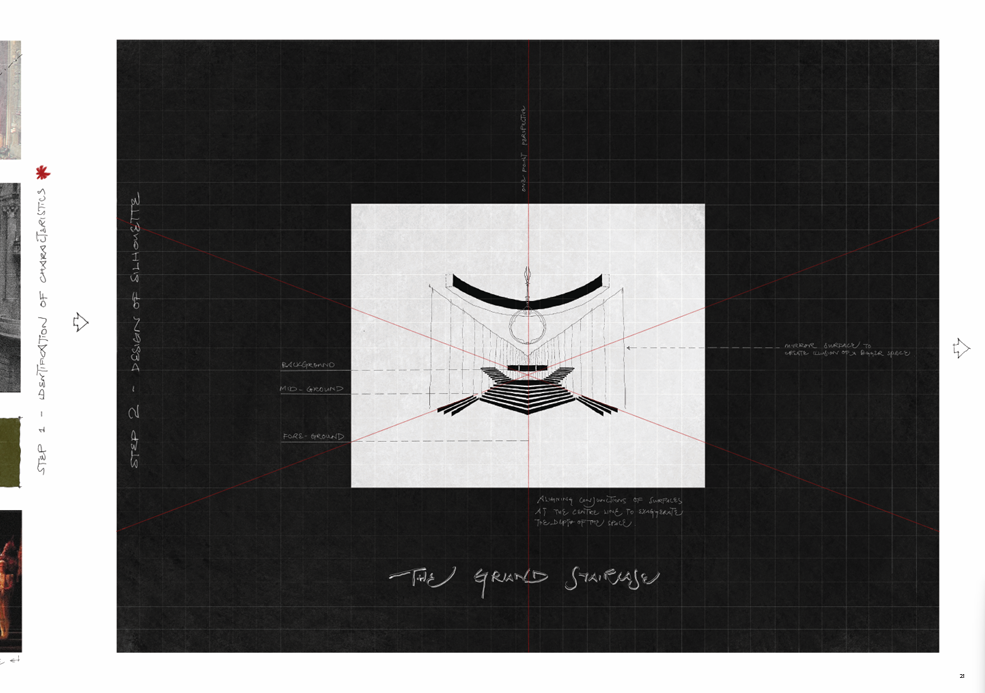
比比納的繪圖不僅是再現工具,更是生成性設計方法。他透過角透視所展開的多點視角,導入斜角構圖與多消失點配置,使空間中展現出動態與深度感。藉由誇張的比例與強化的透視效果操作建築元素,如柱列與階梯,他從特定觀看視角創造出壯麗的幻象。這些技術並非單純的藝術裝飾,而是建構變化舞台空間的核心方法論。
本論文主張:透視繪圖不只是再現工具,更是一種能夠形塑空間經驗的主動設計策略。目標如下:
– 透過透視圖分析,建立一套設計方法論
– 擇定一部合適的劇作作為試驗場域並進行分析
– 將方法論應用於選定的歌劇/音樂劇,重構其空間特質
– 觀察其劇場體驗成果,並回饋修正設計方法論
最終,創造一種沉浸式、連續性的空間場景,使觀眾的移動與感知成為敘事的一部分。這種手法挑戰了傳統鏡框式劇場的靜態性,轉而提倡一種經過重新編排的劇作體驗,讓觀眾與建築空間建立動態的參與關係。藉由以當代表達重新詮釋歷史技術,本研究主張透視繪圖作為一種持續有效的工具,能重新定義人與空間之間的互動關係。
–
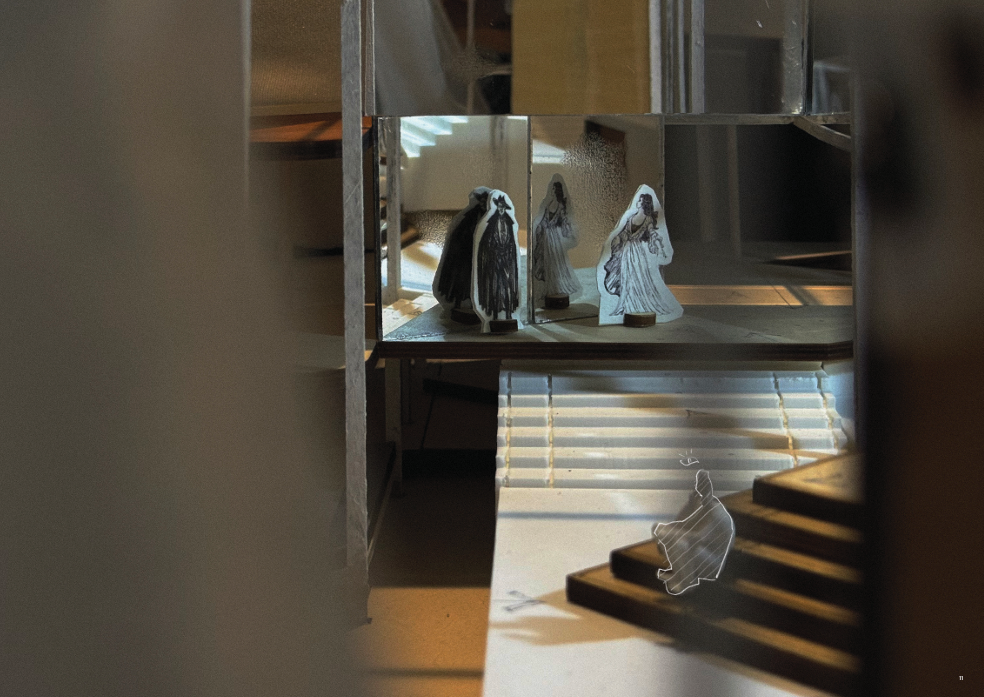
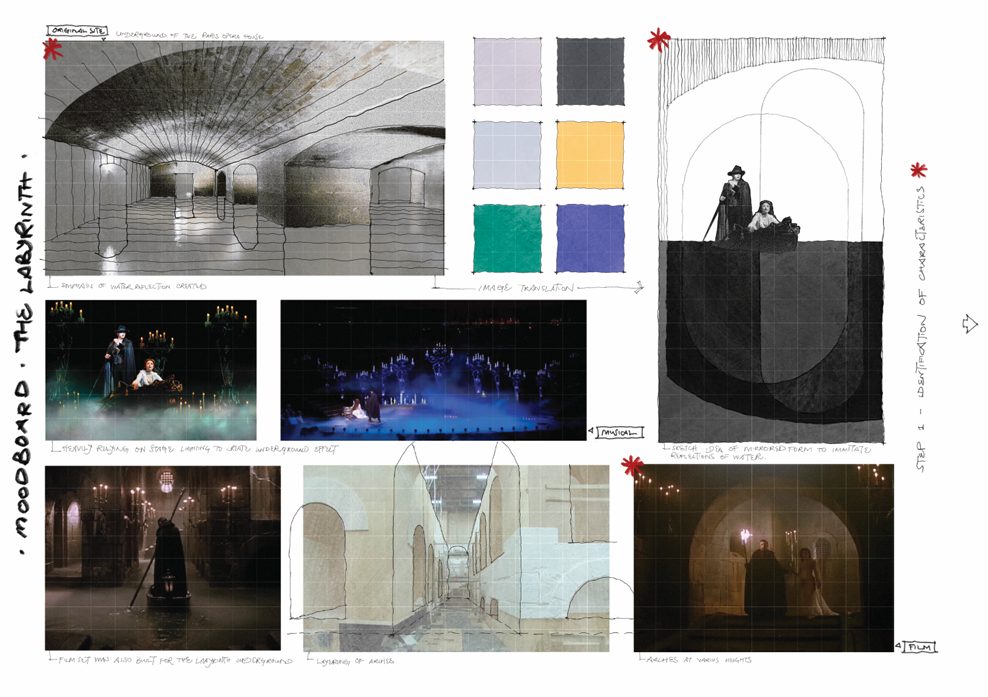
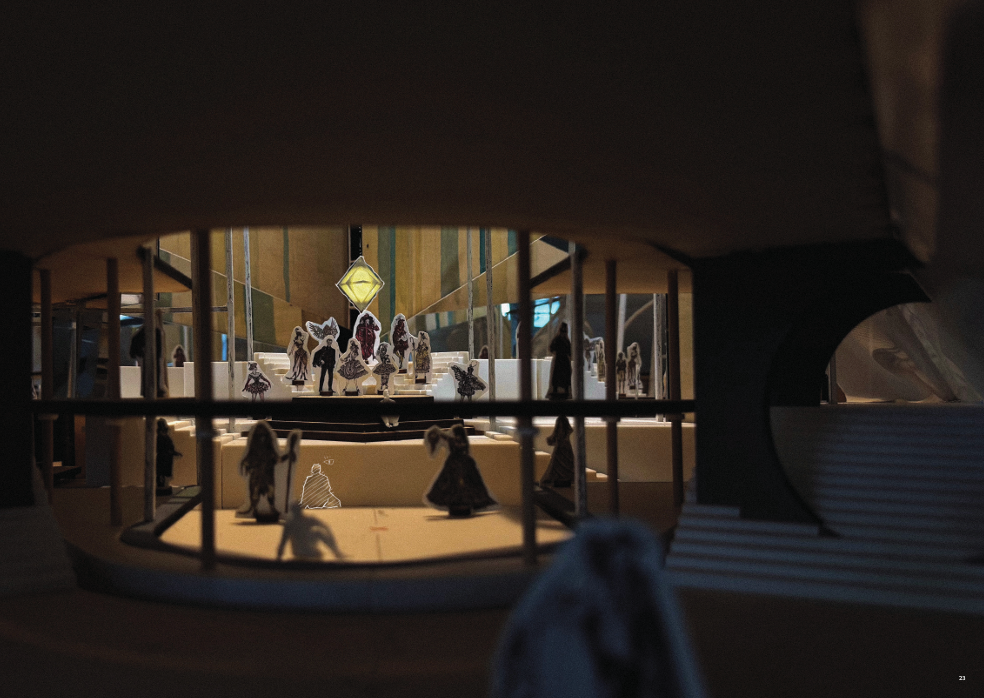
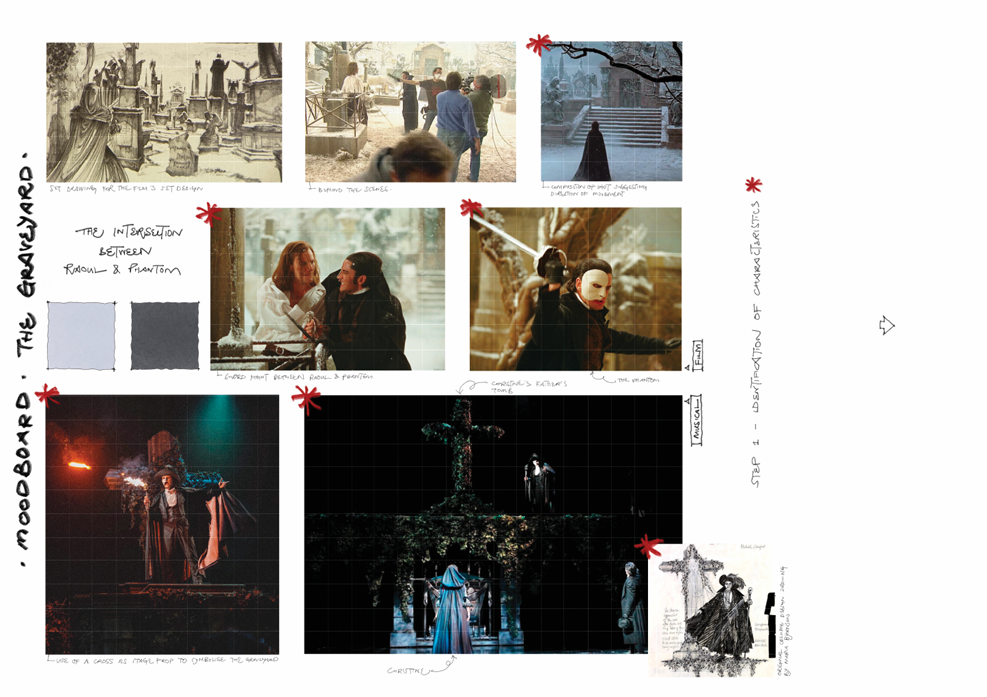
Theatre spaces reveal themselves as a space composed of thresholds and framed views. Theatregoers spend most of the time in the auditorium, experiencing the entire journey from a fixed perspective. This typical theatre setting limits the interaction between theatregoers, performers, and the designed space. This project explores the potential of perspective drawings, a methodology-driven study that encourages intuitive and active participation in image creation that influences human experience within a theatre space. Through studying set designs of Giuseppe Galli Bibiena, a methodology was developed through dissecting his perspective drawings. Attaching myself to one of the classics: The Phantom of the Opera, this methodology was applied to design spaces by reversing the process of the study. Each drawing developed from silhouettes of openings and surfaces is then collaged in sequence as a guide, shaping an immersive performance environment that exhibits a continuous sequential and participatory theatre-going experience. The architecture of theatre has historically been characterised by its ability to frame narratives through spatial and visual constructs. Traditional proscenium stages, defined by fixed sightlines and rigid geometries, have conditioned audiences to engage with performances primarily as passive observers rather than as active participants. This project aims to interrogate the conventional theatre experience by reimagining set design through the framework of perspective drawing—a methodology that not only shapes spatial arrangements but also influences perception and engagement. In traditional theatre practice, the architect is responsible for designing the structural container (the building), while the scenographer focuses on the content (the stage). This project seeks to dissolve that division by allowing the architectural qualities of scenic drawings to exert a designed influence on theatre spaces, thereby positioning architecture itself as a form of scenography.
The use of perspective in theatre design can be traced back to the Renaissance, during which artists such as Sebastiano Serlio and the Bibiena family transformed stagecraft through illusionistic techniques. Notably, Giuseppe Galli Bibiena employed scena per angolo (angled perspective) to create dynamic, multi-focal stage designs that diverged from the traditional single vanishing point approach. His work exemplified how perspective drawings could manipulate spatial belief, drawing audiences into immersive environments. Within architectural discourse, perspective drawings have functioned both as representational tools and as generative design methods.
Giuseppe Galli Bibiena (1696–1757), a prominent member of the distinguished Bibiena family of Baroque stage designers, fundamentally redefined theatrical space through his exceptional mastery of perspective drawing. In contrast to the single vanishing point perspective employed by Renaissance artists such as Serlio, Bibiena introduced scena per angolo (angular perspective), a dynamic system utilising multiple vanishing points to create dramatic and spatially complex stage designs. His work, particularly exemplified in Architetture e Prospettive (1740), illustrates how architectural fantasy and perspectival illusion can manipulate audience perception, transforming flat backdrops into seemingly infinite, multi-layered worlds.
Bibiena’s drawings transcended mere representation, functioning as generative tools that fundamentally shaped the theatrical environment. His innovative approach incorporated multi-point perspective through scena per angolo, employing oblique angles and multiple vanishing points to cultivate dynamic movement and depth. By manipulating architectural elements such as columns and staircases through exaggerated scales and forced perspectives, he crafted illusions of grandeur when viewed from specific vantage points. These techniques were not merely artistic embellishments but essential methodologies for constructing transformative stage spaces.
This thesis positions perspective drawing not merely as a representational device but as an active design methodology that shapes spatial experience. The goal is to:
– develop a methodology from the conducted drawing analysis
– attach myself to a play that is suitable as a testing ground and carry out analysis of the play
– apply the methodology to the chosen musical/opera through recreating the spatial quality of the play
– spectate the outcome of the reimagined theatre experience and refine the methodology
Ultimately, creating an immersive, sequential environment where the audience’s movement and perception are integral to the narrative. This approach challenges the static nature of proscenium theatres, proposing instead a re-choreographed play that encourages a participatory and dynamic experience with the built environment. By reinterpreting historical techniques through a contemporary lens, this thesis argues for the continued relevance of perspective drawing as a means of redefining human engagement with designed space.